
The hedge fund manager is the central figure in any hedge fund structure. They control the investment strategy, make capital allocation decisions, manage risk, and bear ultimate accountability for fund performance. Yet the role is frequently misunderstood, reduced to headlines about returns or compensation rather than examined as the complex operational and fiduciary function it actually is.
Understanding what a hedge fund manager is, what they do, and how they operate within a fund structure is essential for any investor, allocator, or professional engaging with the alternative asset management industry.
Defining the Role
A hedge fund manager is the individual, or team, responsible for running a fund's investment strategy day to day—generating ideas, making investment decisions, sizing positions, and managing risk. This is the role most people picture when they think of a hedge fund manager, and it is the sense in which we use the term throughout this article: in effect, the fund's portfolio manager.
Two further functions sit around that investment role and are often blurred with it. The first is fund governance and control. In a limited-partnership structure this sits with a General Partner—the entity holding ultimate control of, and liability for, the fund—while in a corporate structure it sits with a board of directors, with no General Partner at all. The second is the investment manager (or investment adviser): the regulated entity appointed to exercise discretionary investment authority, holding the necessary permissions and appointing the portfolio managers who run the strategy. In a smaller fund a single principal may occupy all three roles; increasingly, managers keep the day-to-day investment role while a platform partner—such as AKJ—acts as the appointed investment manager, providing the regulatory and structural umbrella (a model we return to below).
The manager's mandate is to generate returns—frequently, though not always, on an absolute-return basis—while managing risk exposures across the portfolio, though the specific objective and constraints vary widely by strategy. Unlike long-only fund managers constrained to holding equities in a benchmark-relative framework, fund managers can draw on a considerably broader toolkit—long and short positions, leverage, derivatives, structured products, illiquid assets, and multi-asset approaches—with any given fund using only the subset its strategy requires.
What Does a Hedge Fund Manager Do?
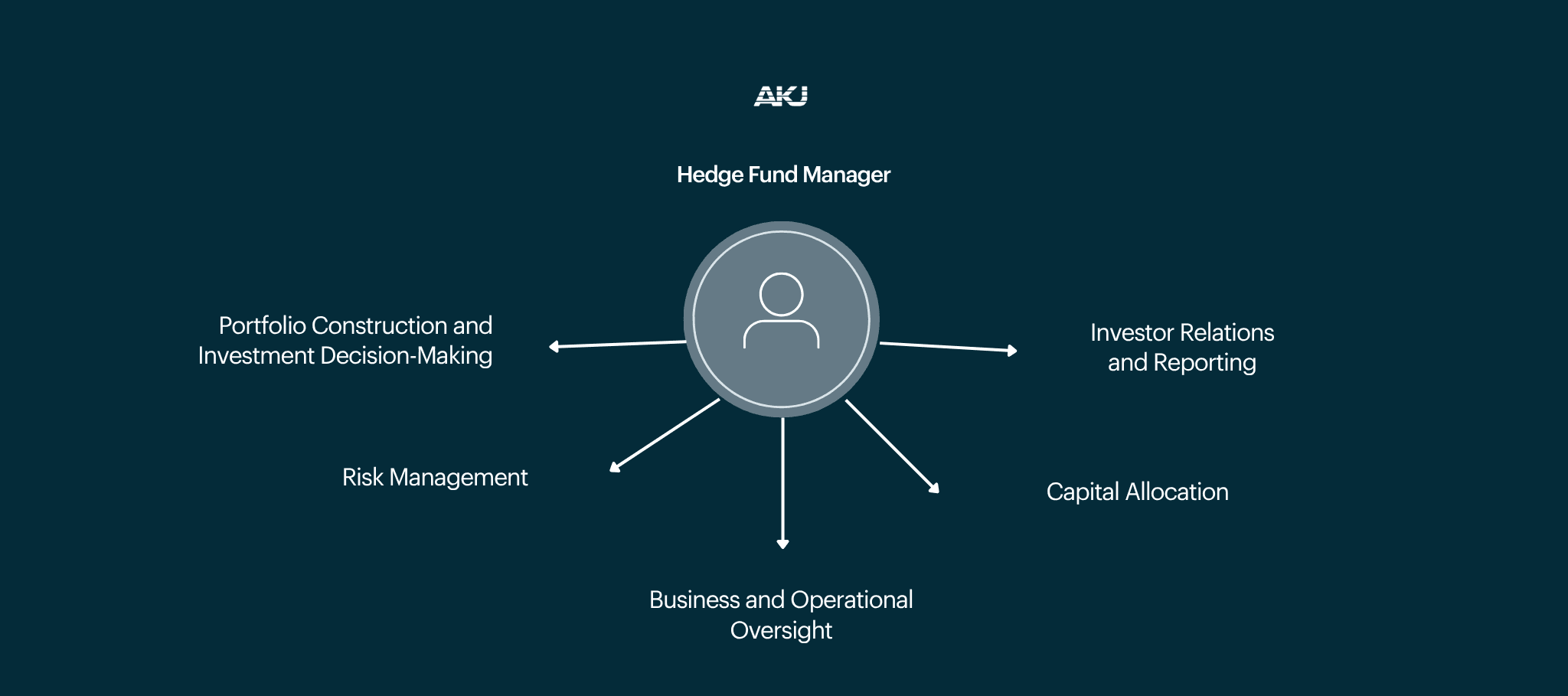
The role spans investment management, risk oversight, business management, and investor relations. In practice, these responsibilities break down across several core functions. And while the manager retains ultimate accountability across them, many are delivered with the support of specialist functions—the fund administrator, investment manager, and prime broker among them—rather than performed by the manager alone.
Portfolio Construction and Investment Decision-Making
At its core, the manager identifies investment opportunities, sizes positions, and constructs a portfolio consistent with the fund's stated strategy. This includes generating trade ideas through research, modelling, or systematic signals; executing entries and exits with consideration for market impact; and continuously reassessing the portfolio as market conditions evolve.
Risk Management
Managing downside exposure is as central to the role as generating returns. Fund managers monitor aggregate portfolio risk across dimensions including market beta, factor exposures, liquidity, leverage, concentration, and counterparty risk. Risk limits are typically defined in the fund's governing documents and reviewed on an ongoing basis.
Capital Allocation
Managers decide how capital is deployed across strategies, asset classes, sectors, and geographies. In multi-strategy or multi-portfolio-manager structures, the manager also oversees internal capital allocation across trading teams or books, acting as an internal allocator as much as an external investor.
Investor Relations and Reporting
Fund managers are accountable to their investors, though much of the underlying execution is handled by specialist functions rather than the manager directly. The fund administrator, for example, independently strikes the Net Asset Value ("NAV"); the manager's role is to review and sign off on it, not to calculate it. This area encompasses investor letters and performance attribution; responding to due diligence requests; managing subscriptions and redemptions; and communicating material developments in the portfolio or business.
Business and Operational Oversight
Particularly at smaller funds, the manager's role extends into business management: managing service provider relationships (prime brokers, administrators, auditors, legal counsel), ensuring regulatory compliance, overseeing technology infrastructure, and maintaining the operational controls that underpin fund integrity.
The Hedge Fund Manager Within the Fund Structure
The legal form of a hedge fund varies with its domicile. Corporate structures—investment companies with variable capital, such as SICAVs—are governed by a board of directors, whereas limited-partnership structures are controlled by a General Partner on behalf of the Limited Partners. Most major fund domiciles accommodate both forms: the Cayman Islands, for instance, is used for exempted companies and exempted limited partnerships alike, while Luxembourg and Malta each offer corporate and partnership vehicles depending on the strategy and investor base. In every case an investment manager is appointed to exercise discretionary authority over the portfolio; where the fund is a limited partnership, the management company also acts as, or controls, the General Partner. Investors participate as shareholders or Limited Partners, providing capital but bearing no management liability.
The management company—often a separately incorporated entity—employs the investment and operational staff, holds the regulatory licences, and enters into contracts with service providers. The fund vehicle itself is a separate legal entity, and its domicile is chosen for tax, regulatory, and investor considerations—the Cayman Islands remains the most common offshore choice, while Luxembourg and Malta are widely used for EU-regulated structures.
This separation is not merely structural formality. It defines liability, regulatory perimeter, and the commercial terms under which the manager earns its fees. It is also what allows the investment-manager role to be delegated to a platform partner—the model we turn to next.
How Are Hedge Fund Managers Compensated?
Fund managers are compensated through a combination of management fees and performance fees—a structure commonly referred to as "two and twenty," though actual fee terms vary significantly across the industry.
Management Fee
An annual fee—typically 1–2% of Assets Under Management ("AUM")—charged regardless of performance. It covers operational costs, staff compensation, and infrastructure. For smaller funds, management fees alone are often insufficient to cover fixed costs, making performance fees essential to business viability.
Performance Fee
A share of profits—typically 15–20%—earned above a defined threshold. Most funds include a high-water mark provision, meaning the manager only earns a performance fee on new net profits, not on recovering previously lost ground. Some funds also apply a hurdle rate, requiring returns to exceed a benchmark (often SOFR or a fixed rate) before the performance fee accrues.
Fee pressure has intensified over the past decade as institutional allocators have gained leverage. Many established managers have maintained premium fee structures, while emerging managers frequently offer reduced fees or co-investment rights to attract early capital.
Skills and Background of a Hedge Fund Manager
There is no single pathway into hedge fund management, but certain backgrounds are strongly represented across the industry.
Investment Banking and Sales & Trading
Many managers come from investment bank trading desks or coverage roles, where they develop market intuition, risk discipline, and the ability to execute under pressure. Fixed income and derivatives desks in particular produce a significant proportion of credit and macro managers.
Long-Only Asset Management
Analysts and portfolio managers from traditional asset management bring deep fundamental research skills and experience managing client capital within institutional frameworks.
Quantitative Research and Engineering
The growth of systematic and quantitative strategies has brought a significant cohort of mathematicians, physicists, and computer scientists into fund management. Technical depth in modelling, data processing, and execution infrastructure is increasingly valued across the industry.
Core Competencies
Regardless of background, effective fund managers typically demonstrate:
• Rigorous analytical and research capabilities
• Disciplined risk management and the ability to manage drawdowns
• Sound capital allocation judgment under uncertainty
• Communication skills for investor and stakeholder engagement
• Business and operational awareness beyond the investment portfolio
Regulatory Requirements
Fund managers operating in major jurisdictions are subject to regulatory oversight, and the compliance burden has increased materially since the post-2008 regulatory expansion. Much of this burden falls on the investment manager—the regulated entity that holds the fund's permissions—which is why many managers choose to operate under a platform partner's authorisations rather than seeking their own.
United Kingdom
Managers are regulated by the Financial Conduct Authority ("FCA"). Those managing Alternative Investment Funds above defined thresholds are subject to the UK's alternative investment fund framework, which sets expectations around risk management, reporting, and investor disclosure.
European Union
The EU's alternative investment fund regime governs managers operating or marketing within the EU. Post-Brexit UK managers marketing into Europe typically rely on national placement routes or establish an EU-regulated presence to maintain access.
United States
Managers exceeding defined AUM thresholds register as Investment Advisers with the Securities and Exchange Commission ("SEC"). Registration brings periodic disclosure and reporting obligations, and strategies involving commodities or derivatives may trigger additional requirements.
Individual portfolio managers are subject to personal regulatory authorisation requirements in the jurisdictions where they operate.
Common Challenges Hedge Fund Managers Face
Even a strong investment track record does not insulate a manager from a recurring set of structural and operational challenges. Five in particular tend to define the difficulties managers face as they build and scale a fund.
Capital Raising
Securing institutional capital is the primary challenge for most emerging managers. Allocators—particularly pension funds, endowments, and sovereign wealth funds—conduct extensive operational and investment due diligence before committing. A manager's operational infrastructure, governance framework, and track record carry as much weight as strategy returns.
Operational Complexity
Managing a fund involves far more than running a portfolio. Trade settlement, reconciliation, NAV production, regulatory reporting, and investor servicing all require robust infrastructure. Operational failures—regardless of investment performance—can prove fatal to investor confidence and fund viability.
Regulatory Burden
Expanding compliance requirements demand dedicated resources. Obligations under regimes such as AIFMD, MiFID II, and the Senior Managers and Certification Regime ("SMCR") impose ongoing costs and documentation demands that grow with AUM and strategy complexity.
Fee Pressure and Competitive Dynamics
The proliferation of hedge fund strategies, growing allocator sophistication, and the availability of cheaper systematic alternatives have compressed fees across the industry. Managers must demonstrate consistent, differentiated returns to justify institutional fee terms.
Talent and Retention
Attracting and retaining skilled investment professionals is a persistent challenge. Compensation benchmarks at established funds are high, and key-person risk—where a fund's viability depends on a small number of individuals—remains a significant concern for allocators.
How Platform Models Support Hedge Fund Managers
Building a hedge fund from scratch requires constructing operational infrastructure alongside the investment business—a dual burden that consumes capital, management attention, and time. Platform models provide an alternative: a platform partner acts as the appointed investment manager—holding the regulatory permissions and providing the operational and structural wrapper—while the manager focuses on running the portfolio. This centralises infrastructure, service provider coordination, and regulatory frameworks within a shared operating structure.
For fund managers, operating within a platform can deliver:

Reduced Time to Launch
Pre-built relationships with prime brokers, administrators, auditors, and legal counsel reduce the time and capital required to establish a fund. Managers access institutional-grade infrastructure from day one rather than building it incrementally.
Operational Focus
With trade processing, reconciliation, risk reporting, and investor servicing managed through the platform's infrastructure, portfolio managers can concentrate on investment activity rather than operational administration.
Institutional Credibility
Allocators conducting operational due diligence assess the fund's infrastructure, controls, and governance alongside investment strategy. A manager operating within an established platform framework benefits from the credibility and track record of that infrastructure.
Scalability
Platform infrastructure scales with AUM without requiring proportional increases in internal headcount or fixed costs. Growth in assets, or the addition of new strategies, is absorbed by the platform rather than capped by the manager's own operational capacity.
Economies of Scale
Because infrastructure, service-provider relationships, and regulatory permissions are shared across multiple managers, the cost of institutional-grade operations is spread across a far wider base than any single fund could support alone. Managers benefit from negotiated terms with prime brokers, administrators, and other counterparties—and from systems and expertise—that would be uneconomic to procure independently at launch.
Final Thoughts
The hedge fund manager role is one of the most demanding in financial services: combining investment expertise with business management, regulatory accountability, and the constant pressure of investor expectations. Performance alone does not determine success. Operational discipline, governance credibility, and the ability to scale sustainably are equally determinative of long-term viability.
Strategy generates returns. Infrastructure determines whether the business survives long enough to compound them.
For managers at the early or growth stage of building a fund, the operational and structural decisions made at launch have lasting consequences. This is where a platform model proves its value—giving managers a route to institutional-grade infrastructure without the time and capital cost of building it alone.
If you are considering launching or scaling a hedge fund, contact AKJ to discuss how an integrated platform structure—with AKJ acting as your appointed investment manager—can support your business from day one.
Alternatively, explore our platform services to understand how institutional infrastructure can be implemented without building it from the ground up.
Key Takeaways
• A hedge fund manager is responsible for investment decisions, risk management, and fund operations—not investment returns alone.
• The day-to-day manager runs the strategy, while fund governance (a General Partner in partnership structures, a board of directors in corporate ones) and the appointed investment-manager role may sit with the same firm or with a platform partner such as AKJ.
• The role spans portfolio construction, risk oversight, investor relations, regulatory compliance, and business management.
• Strategy type—long/short equity, macro, quant, credit, event-driven, or multi-strategy—defines the specific skills and infrastructure required.
• Compensation through management and performance fees incentivises long-term performance, but fee structures are under sustained pressure.
• Operational infrastructure is as critical to fund success as investment strategy—allocators assess both in equal measure.
• Platform models provide fund managers with institutional infrastructure, service provider coordination, and operational scalability without the cost of building internally.
Frequently Asked Questions